

Derek: Part of Balinese culture which has been increasingly offered to visitors is the water purification ritual. Water is considered holy as it is so fundamental to life, and particularly present in the rice paddies and environment here. We learned more later about the theme of purification and cleansing which is present in Balinese life from before birth through past death. The Melukat ritual is centered on washing away negativity of thought, speech, and action.
The purification can be done anywhere, but there are some temples with fresh springs pouring into pools dedicated to it. Pura Mengening was built in 1022 CE (74 years before Oxford University) and eventually was covered by the jungle. It was rediscovered twice, once around 1926 and again in 1960. It has twelve pools which are used for different purposes.


I was interested in experiencing a small part of the Balinese spiritual practice and found Ketut Rauh, a local guide, who would lead me through the experience. We came at 9 AM just as the temple opened and were nearly alone with a few people walking around and three people also at the Tirta Sudamala pool. I won’t try to describe much of the ceremony as I have only a basic understanding of it. I feel that it was valuable to me and am pleased I was able to take part in it. I am grateful to the Balinese people for feeling that this part of their spirituality is appropriate for new people.
Charis: Our next stop on our road trip up to Amed was the Mount Batur Geopark’s Museum on the rim of Mount Batur’s second caldera. This was a fun little stop that explained the volcanic history of the area, it’s UNESCO Global Geopark status and also had exhibits about the flora, fauna and culture of Bali.


We stopped off at Akasa for lunch, a little further east on the rim. Walking in felt like entering an open air theatre – the seats and tables were arranged in steps all facing out to a magnificent view of Mount Batur and Lake Batur in the distance. You could see the areas of lava flow mentioned at the Geopark museum as large dark rocky areas on the south side of the volcano. Very cool!
Derek: The Samsara Living Museum is in the town of Jungatan in the north eastern area of Bali. Founded about six years ago its goal is to record and preserve the meaning and relevance of Balinese life and practices. They strongly feel that there has been a recent abandonment of the traditional values and thus a diminishment of the community’s identity. By providing a space to experience and learn the traditions, stories, and practices they hope to bring them to the future generations of Balinese, as well as to visitors.


We saw records and stories engraved onto processed palm leaves, various ceremonial objects with explanations, and ate some pandan, rice, and coconut patties. The kitchen below is actively used in their workshops and, while we didn’t see any like this in the towns we stayed in, is similar to those still used in many more rural households. Interestingly they make Arak, a distilled fermented coconut liquor, here as one of their classes! You can see the still over the fire with a long pipe sloping away for the alcohol vapor to condense in.

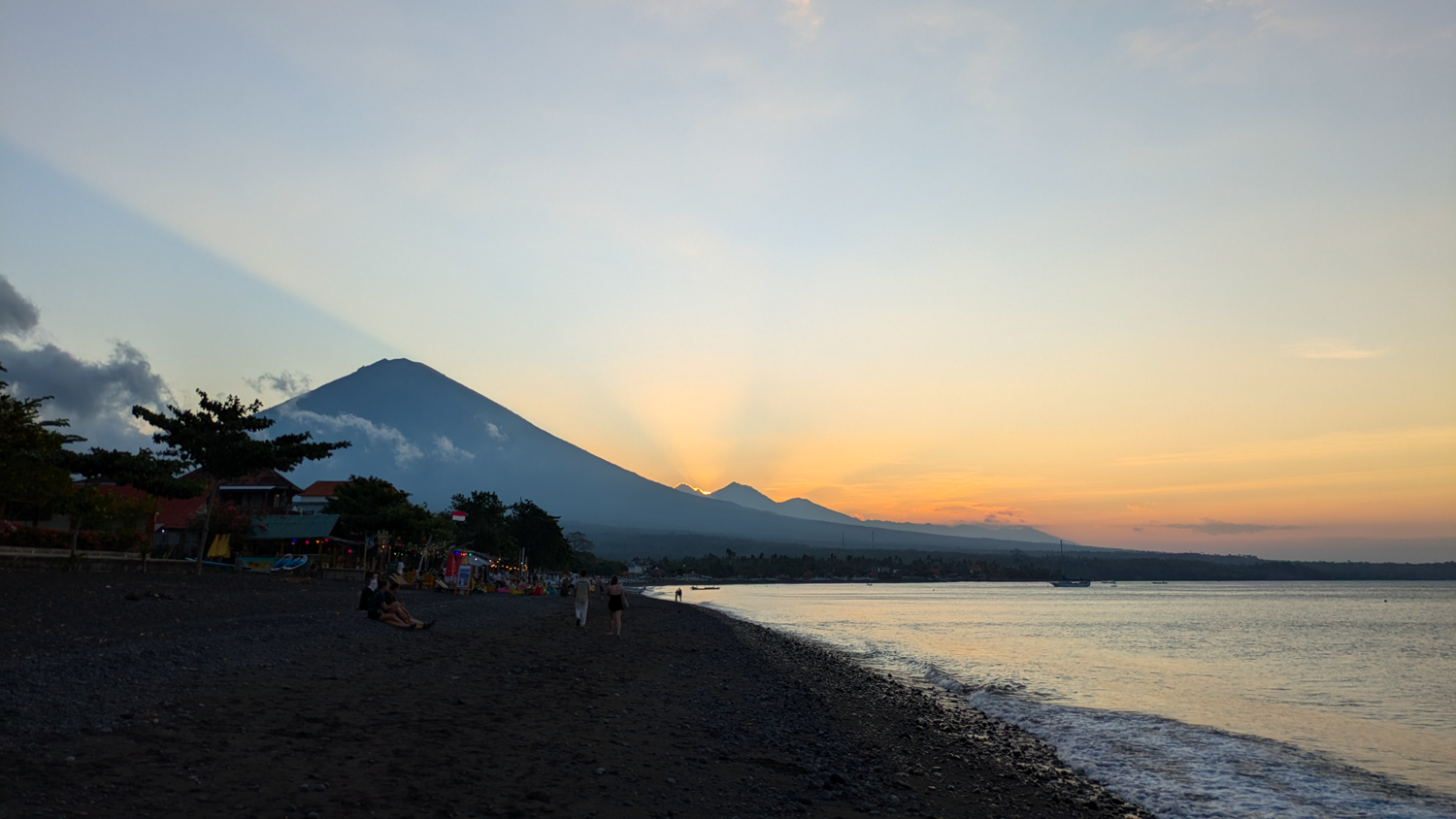
Amed is a fishing town right on the northern coast of Bali and is best known for scuba, free diving, and snorkling. We stayed at in a bungalow behind a warung (restaurant) right in the center of town. We were just a few minutes from the sand and water and had easy access to a wide variety of restaurants. The town was a single main street and very focused on the beach tourism industry.
Charis: Rimba (‘Jungle’ in Bahasa Indonesia) is a lovely little café/restaurant just a few minutes walk from our room which we ended up frequenting very often as their coffee was absolutely fabulous. It helped that they played super chilled lo-fi and had excellent décor, leading to more long chats about how we would like our house to be in the future. One particularly fun feature was a secret door behind one of the decorative Art Deco style arches, and now I think our future house has a secret bar.


Admittedly, the diving didn’t go so well for me. As like a year ago in Mallorca, my body had difficulty remembering it was possible to breathe underwater with a scuba tank and it was very hard to control the rate of my breathing, even during the refresher dive in the pool. I could find loads of excuses as to why it didn’t work out (I don’t think I had enough weights therefore my buoyancy was messed up, my nose piercings made it hurt to equalize my ears blah blah blah) but ultimately I struggled to go down and ended up bailing. Sulking in the scuba truck did let me start my third Amed book though, so it wasn’t an entirely wasted morning.
A few days later we decided to try snorkeling, borrowing some gear from a local stall and going in from the beach almost directly opposite where we were staying. Being on the surface meant I didn’t have to worry about buoyancy which helped loads, and we spent a good hour or so ogling the lovely coral reefs and fish. Unfortunately our masks weren’t prepped as well as on the dive, so we did get a fair bit of misting. The waves were fairly strong too and despite our best efforts, I ended up abrading myself on the coral and getting multiple facefuls of seawater in my struggle to get back on to the shore – I’m sure hilarious to watch but I was a bit miffed by the time I came out and decided maybe me and the sea wouldn’t be friends for a bit. Hmph.


Derek: I’ve been on good terms with the ocean for a long time and was keenly interested in diving, so went out a total of three days to see some of the different sites. The first day included the USAT Liberty, an American Army cargo ship built just too late for World War I and which was torpedoed near Bali in 1942 and run aground by its crew. In 1963 the earthquakes from Mount Agung erupting caused it to slide fully into the water and lay just under the surface. Since then it has continued to decay and become covered in coral. It is a very popular and busy dive site, and absolutely delivered on the hype. I loved rolling the the water and seeing the large ribs and fragments of ship surrounded by the blue water and tons of fish. We swam into the hold and through a passageway at the bow. At the end we passed over a large area of sand with about a hundred thin eels emerging from the ground and swaying in the water like kelp.
The other dives were a slow drift past a series of ~5 meter (15 feet) tall artificial concrete pyramidal structures sunk as artificial reefs where we saw several sea turtles and three wall dives where the ocean sunk away beneath us and went dark blue out from the coast. On the last dive I used enriched air, with 29% oxygen, which allows you to stay at a given depth longer as you absorb less nitrogen into your blood. That was a new experience but happily one which pretty much felt the same as usual, a nice technique to add to the toolkit for future trips. Sorry I don’t have photos, so I’ll point you towards Amed White Sands Divers’s gallery.
Charis: Overall, Amed was lovely, but very much focused on diving and with it being so hot and me being raised in Scotland, it was hard to do much else during the day. We decided to head back up to Kintamani and Mount Batur in our second week to be able to do a bit more hiking and exploring in the reduced high-altitude temperatures.
Crochet wise, I completed my first cardigan! It’s not very even, I managed to drop a stitch on one of my side panels, didn’t decrease the sleeves properly, did different bindings on the cuffs and collar and made it a bit too small (again), but it is complete! My first time doing sleeves and I learned flo hdc, flo hdc decrease, fphdc and bphdc stitches so overall I’m quite proud of myself. I still have loads of yarn, so I think I’m going to do a granny square shoulder bag next – I do have a tote bag with me but prefer a crossbody carry, so will see what I can come up with.

Derek: In the Kintamani area we stayed at a hotel in the crater, right at the base of Mount Batur and just a short walk from the lake. The pool was fed by natural hot springs and was fantastic to soak in, which we did three evenings in a row as the sun was setting. The air temperature was a fantastic 24C and we got some hiking in. Just doing a small loop through the nearby forest on Mount Batur’s foothills we passed three temples, including one which seemed half overtaken by plants.


One of our main reasons for coming back to the Kintamani area was to find out more about how coffee is grown locally as we’d really been enjoying drinking it for the past five weeks. Most of the tours seemed to be pretty superficial tourist traps, but thanks to one post on Reddit we found Eco Bike Coffee Bali. They have (if you ask… its terribly advertised) a five hour coffee tour experience which puts you hands on every step of the harvesting and production. We sadly didn’t get to ride in the jeep, but it does look good! They work with about 16 small family farms just across the street from their shop and workspace. Each year they harvest about 6000 Kg of ripe coffee berries (we probably managed about three), process them, and sell nearly all of it directly in their store.


We sorted the ripe berries from the under-ripe berries and then our tour guide Made poured them through the pulping machine which removes the red skin. The beans are still covered in a white fruity flesh, which actually tastes quite nice. These get washed several times before being put in a large barrel to ferment. The fermentation changes the flavor of the beans and softens the fruit flesh making it easy to wash off. Different processes involve leaving the outer skin on and fermenting, taking the skin off and fermenting for different durations, and fermenting it with the addition of koji spores, similar to how sake and miso are made! There’s a good write up by Bean n Bean here.
After fermentation and washing, the beans are laid out, first in the open air and then in polytunnels, to dry till about 12% hydration. Here we can see that the current beans are at 16.9% so still need a few days. The drying process takes about three weeks for washed beans and four weeks for those with the skin left on (natural process).


Charis: From there, the beans are taken to be roasted. They have a huge Vietnamese roaster for their big batches, but pulled out a cool little home-roasting machine for the little batch we did. The beans are hot-air roasted for 8 minutes, and we tried three different batches; washed, honey processed and koji processed.


And finally we got to the cupping stage! The freshly roasted beans were ground and mixed with boiling water so each type could be tasted and compared to the other two. We both decided that the koji was our favourite – this is quite a new processing type which neither of us had tried before, so it was a lovely surprise! We got to take several bags away with us, but unfortunately as we were maxed out with our luggage we couldn’t take them with us, so they ended up as a present for Pepe, the lovely driver who took us to our final hotel.


Derek: After a few days in Kintamani we got our now good friend Pepe back to drive us to Kuta to be near the airport for our early morning flight. We had another passenger along for half of the ride, Deniz, who has been long-term traveling over the past several years and has a travel blog called Drop in the Ocean. She was in Batur and we met each other at a coffee shop getting lunch. She was headed to Ubud next which was directly on our way to Kuta.
There was one last spot to drop into on our way, Pura Gunung Kawi Sebatu. This is another temple which prominently celebrates water, similar to Pura Mengening. It is a little newer, built between 1300 CE and 1500 CE, and had wonderful shrines which we were able to approach. Till now, we had been admiring the painted wooden shrines from a distance or glimpses as they rose over walls, here we were free to spend time looking closely. It was a bit more busy than Pura Mengening, but not so much as to be hard to enjoy. We enjoyed a walk around, dropped Deniz off in Ubud, and finished the drive down with a bit of sing along to our and Pepe’s favorite songs, an eclectic mix.


Charis: Our last stop in Bali was in Kuta, where we had booked a hotel for the night prior to our early morning flight the next day. Kuta Beach is famous for surfing and sunsets – we enjoyed a lovely walk down it in the afternoon, but unfortunately didn’t quite get the full sunset effect due to clouds! Regardless, it was still beautiful and a fitting end to our time in Bali.


The next morning we were up bright and early to head back to the airport on our way to Tokyo (for real this time!).