
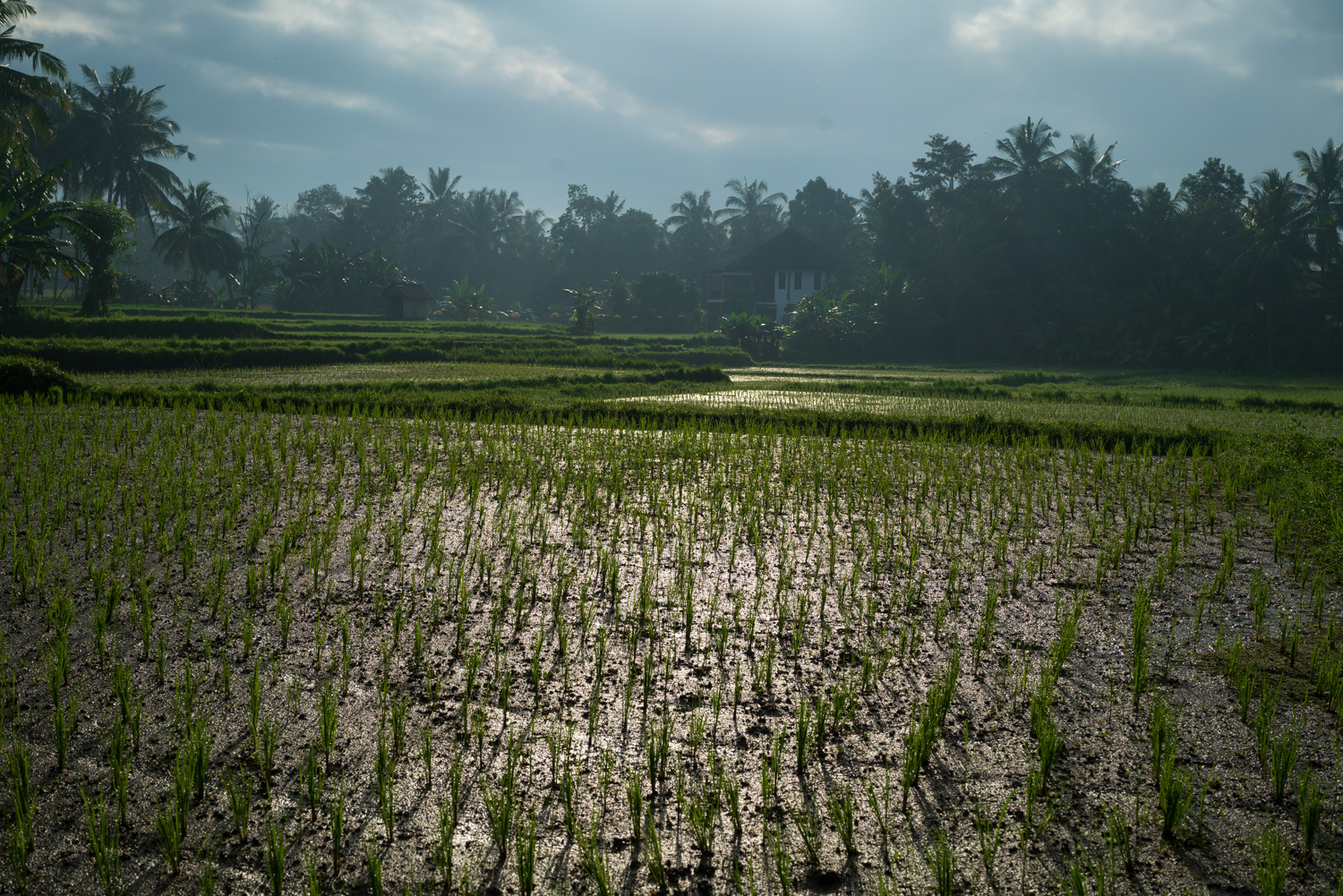
Charis: The first place we stayed in Ubud was in a small villa along Subak Juwuk Manis, a pedestrian and bike only path to the north of town at the start of the rice fields. This gave us the perfect setting for many beautiful early morning walks, watching the ducks splash in the soaked rice paddies and stopping in at little warungs for coffee or banana pancakes.


These walks were gorgeous, and probably one of my favourite things about staying in Ubud.


Being out in the sticks also meant that we had an insect, frog and bird symphony to help us get to sleep every night!


We got to see several of the nearby fields turned over by the local farmers – due to the Subak system mentioned previously, the paddies were in various states from fallow to almost ready to harvest. The ploughing was performed by a large petrol driven but hand steered machine and the farmers would sludge through the mud with their bare feet, with the mud almost reaching up to their knees! Pretty gnarly, it looked like very hard work.
Derek: Pura Taman Kemuda Saraswati is a temple in the center of Ubud dedicated to the Goddess Saraswati. Only the front area with a bridge over the pond with lotuses and fish is accessible to tourists. The main temple is kept for worshipers. The temple hosts dances and performances most nights, which we did not end up going to. In hindsight there are many temples within fairly easy walking or driving distance which have similar architecture and are larger or more open. If you happen to end up in Ubud, maybe get a coffee at the cafe and take a look in from there, you’ll be able to see everything.


More interesting was the Puri Lukisan Museum of Balinese Art just a few roads over. Spread over five buildings it mostly had paintings and drawings spanning several hundred years of Balinese art, largely from the Ubud area. It was founded during the period when the first foreign artists were coming to Bali and exchanging new styles and ideas with the local artisans. About a third of the art was from the past 75 years with many artists still being alive, though with little to no information about whether they continue to create. We really enjoyed seeing the galleries and recommend it as a good hour or two break from the sun.


My street photography career hasn’t kicked off yet so you won’t have noticed just how many Balinese wear sarongs and traditional clothing in their day to day life. I’m pretty sure we’ll talk more in depth about the clothing later in this or the next post, but the fabric itself is the focus for right now. We visited two stores (and passed probably a hundred little stalls) selling sarongs, shirts, dresses, and other examples of cloth. The Threads of Life store had videos and write-ups of several styles and techniques from across the Indonesian archipelago.
The Ikat technique actually dyes the pattern into the thread before it is all woven together. Thousands of knots and tight wrappings are made onto the thread after stringing it onto a loom and then everything is dipped into dye. Anywhere the thread is wrapped will resist the dye soaking in, creating a lighter area. This can be done multiple times to create several shades of color in the thread. Once the pattern is dyed in the weaving then turns it into fabric.
Batik is the second common technique in Bali. Thread is woven into fabric then applying liquid wax which will block dye from soaking in. This process of adding wax and dipping in dye can be done several times to create a pattern of multiple shades or colors. We wanted to learn more about this as well as how natural dyes were made from local plants and materials so joined a workshop.
Charis: Indigo production in particular was highlighted, as the method used in this half day batik course. The indigo leaves are harvested, covered with water and allowed to ferment for a few days. The leaves are then removed from the water and calcium carbonate (limestone) is added, turning the liquid a chalky yellowish green. The mixture is then aerated by collecting and tipping the liquid back into the container several times – this oxidizes the mixture and turns it a vibrant deep blue. The precipitate is then collected as a dark blue sludge – indigo paste. This can be added to water to create a dye bath or dehydrated to make indigo powder, shelf stable and ready for transport or export.


We were given a square of white fabric, a pot of simmering wax, and a collection of pen applicators, brushes, and stamps to create our own design.


After applying wax and dying the fabric two times the wax was removed to reveal the final result, a pattern of white (where wax was applied first), light blue (from the second application), and dark blue where the fabric absorbed dye twice.

This was a really fun process and really made me want to spend more time experimenting. Wayan, who led the class, explained that indigo really prefers a colder climate (though I’m not sure as cold as Wales!) so I would love to see if it would grow at home.
My fabric appetite whetted, we also went on a trip to the Ikat Batik store in town. The whole shop was gorgeous, demonstrating multiple ikat, batik and tie-dye fabrics, sometimes with more than one technique used on a single piece! There were also quilted pieces and all the dyes were natural – primarily indigo but also browns, greens, yellows and reds. Some of the detail on the batik pieces was awe-inspiring, these pieces must have taken weeks to complete. Unfortunately, restrained by the size of our backpacks we did not come back with half the shop, but they have recently opened an Etsy page so we can fill our boots when we’re back!


Towards the end of our first week we ended up visiting a restaurant called Plant Bistro, a beautiful Italian restaurant and patisserie. It was a bit of a climb back to our villa, so we ended up getting our first scooter ride (available on Grab) to get back home. Grab Bike made a point of saying the driver should offer you a helmet if you don’t have one and mine didn’t, but we still got back within minutes and, given the slopes and tendency to weave through traffic it was quite the exciting ride! For 75p and remaining fully intact, I certainly can’t complain.
Derek: A few days before coming to Bali I decided to find a book about day to day life in Bali and found A Little Bit One o’Clock. The author started visiting Bali in 1987, stayed as a long term guest with a family in Ubud for many years, and built their own home nearby in 1997. The stories in the book are wonderfully unexceptional, the lives and thoughts of a pair of travelers and the family and community that they found themselves surrounded by. I completely missed it in my read through, the authors helped start the Threads of Life store and still are heavily involved with it. The store is located at the home of the family they stayed with!
Balinese families frequently live as in a multi-generational group with a cluster of buildings and a small temple enclosed by a wall. As tourism has ticked up many open their doors to guests and offer rooms, sometimes with breakfast and usually with regular cleaning, labeled as a “homestay”. “Rumah” means home in Indonesian and appears on houses everywhere. The local family in the book includes Darta and his wife Suti as well as siblings, children, and Darta’s mother. Darta’s father was I Nyoman Roda. Balinese names frequently are structured as “I” or “Ni” indicating male or female respectively, followed by one of Wayan, Made, Nyoman, or Ketut indicating if they are the first, second, third etc child, and finally a personal name such as Roda. The personal names are rarely used with strangers and we’ve only learned two while being here. The naming varies by tradition and caste, check out Wikipedia for a little more on Balinese names.
So putting this together, Rumah Roda is still renting rooms in their family housing. Looking at the illustration in the book and the photos on their website a lot has changed in 30 years, but the people are pretty much the same! I did look at staying there but they were booked up as it’s the high season for tourists and they have a great location near the center of Ubud but also close to the Jeruk Manis rice paddy walk. We did stop in to have dinner (good food in a great setting!) and asked if they had a room for one night as we needed to fill a gap before the next accomodation was available. They did and we were able to stay for one night which was a lot of fun.
I chatted with Darta, Adé carried some of our bags up, and Suti cooked us dinner. I really wish we’d been able to book a much longer stay with them as they were so friendly. When we went to their dining area for dinner it turns out some other guests had been socializing and finished off the last of the beer so El, one of the young hosts, had run out and gotten a waterbottle of arak from a local store. Arak is distilled coconut spirits, ~40% alcohol, and turns out to be tasty mixed with coke and lime! We had a glass each but declined going out clubbing with the other guests.
As we were checking out Darta invited us to stay a while as it was a special day (Balinese birthday) for one of the children in the family and a priest would be coming to perform a ceremony in the family temple. I suspect that missing that will be my largest regret from our time here, but we’d made plans and couldn’t easily change them.
Charis: We used the minor moving complication to our advantage, deciding to go on a trip with a driver before moving to our third accommodation, therefore avoiding too much tromping through town with our backpacks. We headed northwest of Ubud and to our first stop at the Sangeh Monkey Forest – a 6 acre monkey sanctuary and temple.


It was pretty crowded, with 3 different troops of long-tailed grey macaques within the park, which meant lots of competition for the peanuts we were given on entry!
Our second stop was the Pengempan Waterfall. A beautiful and very quiet spot surrounded by jungle. Lots of stairs heading down, which we took slowly to avoid stepping on lizards basking in the sun. At the bottom we came to the waterfall and clear pool below, which looked like something from a storybook. We regretted leaving our swimming costumes in our bags, but admittedly making the trek back up whilst sodden wouldn’t have been particularly pleasant. We enjoyed the atmosphere (except the plastic littering, boo), the sounds of the jungle and the multiple brightly coloured dragonflies buzzing around before returning to the car and onward to our third destination.

Which was the JungleGold Chocolate Factory! We’d found one of their shops in Ubud a few days before and on reading up on them a bit more, discovered that all of their chocolate was vegan (using oat, cashew and coconut milk for creaminess) and produced locally, with cacao beans coming from the factory site itself, elsewhere in Bali and Java. We were given a tour of their small on-site cacao plantation and even got to try the sweet white fruit surrounding the beans! We then were talked through the roasting, grinding and tempering process, getting to see the roaster in action and the factory staff making chocolates in molds.


It was really fun to see and we rounded the tour off with a stop in their cafe, where we had fresh strawberries with chocolate fondue and got to make our own chocolate bar – 64%, with shredded coconut and cocoa nibs – delicious!


Finally, we headed north again and up to Ulun Danu Beratan Temple, on Lake Beratan. The setting was stunning, but unfortunately we hadn’t realised quite how touristy it was going to be mid afternoon. We enjoyed a walk around in the cooler mountain air and the views, but decided not to hang around too long and get out of the way of everyone trying to take photoshoots!


Our final week in Ubud we were based in Penestanan, a small village/suburb to the west of Ubud. It definitely had more of a hippie vibe, with loads of vegan eateries, yoga studios and notice boards advertising everything from sound healing to past-life regression sessions.
We made use of the former, if not the latter, and went a few times to Alchemy Yoga Centre – a very aesthetic group of open-air bamboo structures big enough to hold yoga classes, meditation sessions and ecstatic dance classes.

The yin session of an evening with candles flickering was particularly nice, and I don’t think I’ve sweated more this whole trip than whilst trying to do a 90 minute flow class in 30 degree heat! The sessions were very enjoyable, and rounded off with a fabulous meal at the Alchemy vegan restaurant opposite afterwards.
Penestanan also had lots of fun little walking paths and alleyways, often with the adjacent waterways so common all throughout Bali, making it lots of fun to explore. One particular gem we found was Bamboo Spirit, a small vegetarian restaurant tucked off to one side of the Penestanan Stairs which offers a homemade Indonesian cuisine vegan buffet every Sunday. Delicious!
Derek: From some of the walks we did in the first week we could see the Bukit Campuhan walk which runs along the narrow top of a ridge between two river valleys. The first morning we rose early to hike it the skies opened and it poured. The next morning was back to the usual clear skies and we enjoyed the hike, though it had much more elevation change than others.


After the Batik class, visiting both Threads of Life and Ikat Batik, and spending four weeks with people walking around wearing sarongs I strongly wanted to get one for myself. The traditional Balinese clothing for a man includes the sarong or kamen wrapped with a fold at front, a saput wrapped as a second layer, a selendang waist cloth holding everything up, and an udeng headdress.
There were sarongs for sale in all the market stalls near the tourist attractions and main streets, but a lot were synthetic fabric and designs that I didn’t see locals wearing. I asked one of our drivers for a recommendation and he chased down the store that his school class had all bought their matching clothing for graduation at, Top Tangkas. We took motorbikes over and I bought a batik kamen, and machine printed saput and udeng. I have a lurking suspicion that I either look haphazard or very hip, and I’ve rarely been hip in my life. Charis also picked up two beautiful udeng cloths (left and middle at the top).

All too soon though, it was time to head off again further north, this time to Amed!